
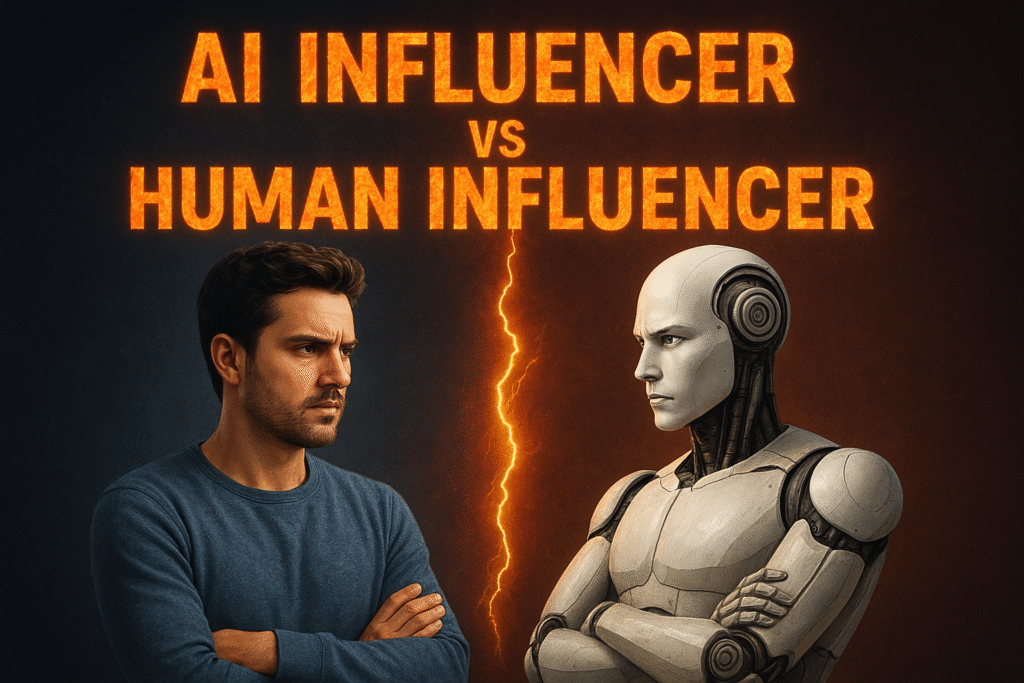
AI Influencer vs Human Influencer: The Real 2025 Battle
Social media is changing fast.
Brands are changing too.
And influencer marketing is evolving faster than ever.
One big question is trending everywhere in the USA:
“Who is better for the future? AI influencers or human influencers?”
Let’s break it down.
Let’s keep it simple.
Let’s talk about what really matters.
What Is an AI Influencer?
AI influencers are not real people.
They are digital personalities.
They are created using advanced AI, CGI, and 3D tools.
They don’t sleep.
They don’t take breaks.
And they never make mistakes.
Some popular AI influencers in the USA are:
- Lil Miquela
- Shudu
- Imma
- Noonoouri
These digital creators look real.
They act real.
They build an audience.
And brands love them because they are predictable.
What About Human Influencers?
Human influencers are real people.
They connect through emotions.
They create content based on real experiences.
They understand culture.
They understand pain.
They understand humor.
Brands trust them for authenticity.
People trust them for personality.
Human influencers have something AI cannot recreate:
Real human connection.
Why AI Influencers Are Growing Fast in the USA
AI influencers are exploding in popularity in the United States.
Here’s why:
1. They are available 24/7
No rest.
No time zone limits.
No personal issues.
They deliver content anytime.
2. They are low-risk for brands
No controversies.
No scandals.
No last-minute cancellations.
3. They are cost-effective
Brands save money.
No travel cost.
No photoshoot cost.
No location cost.
4. They create unlimited content
One idea.
Hundreds of variations.
All fast.
5. They look perfect
Better visuals.
Better styling.
Better consistency.
Why Human Influencers Still Matter
Even with all the hype, human influencers aren’t going anywhere.
1. They create emotional impact
Real emotions.
Real life.
Real stories.
This always wins trust.
2. They understand culture
They know trends.
They know humor.
They know the real audience.
AI cannot feel culture.
AI cannot experience anything.
3. They build deep loyalty
People follow people.
Not perfect digital models.
4. They influence buying decisions
Humans can persuade.
Humans can relate.
Humans can convert.
AI vs Human Influencers: A Clear Comparison
| Feature | AI Influencer | Human Influencer |
|---|---|---|
| Cost | Low | Medium–High |
| Speed | Fast | Moderate |
| Authenticity | Low | High |
| Creativity | High | Medium |
| Trust Level | Medium | High |
| Risk | Very Low | High |
| Emotional Bond | Low | High |
| Brand Control | 100% | Limited |
What USA Brands Prefer in 2025
USA brands are picking both.
Yes — both.
They want:
- AI influencers for scale
- Human influencers for trust
This mix is becoming the new normal.
It saves money.
It builds credibility.
It improves results.
Big USA brands already using AI influencers:
- Nike
- Prada
- Samsung
- Dior
- Balmain
But brands like:
- Gymshark
- Sephora
- Starbucks
- Amazon
still rely heavily on human creators.
Which One Performs Better on Social Media?
AI Influencers perform better in:
- Fashion campaigns
- Tech promotions
- Virtual photoshoots
- Large-scale content production
Human Influencers perform better in:
- Reviews
- Lifestyle content
- Storytelling
- Long-term community building
- Real conversations
Both have strengths.
Both have weaknesses.
Future Predictions for the USA Market
The USA is already the biggest influencer market in the world.
And the future looks hybrid.
Prediction 1: AI influencers will handle volume
More content.
Faster content.
Cheaper content.
Prediction 2: Human influencers will handle trust
Real faces.
Real opinions.
Real engagement.
Prediction 3: Brands will use both together
AI for aesthetics.
Humans for authenticity.
This combination will dominate the US marketing landscape.
So… Who Will Win? AI or Humans?
The truth is simple:
Both will win.
But in different ways.
AI influencers will win efficiency.
Human influencers will win emotion.
The future of social media is not about choosing one.
It’s about using both together for maximum impact.