
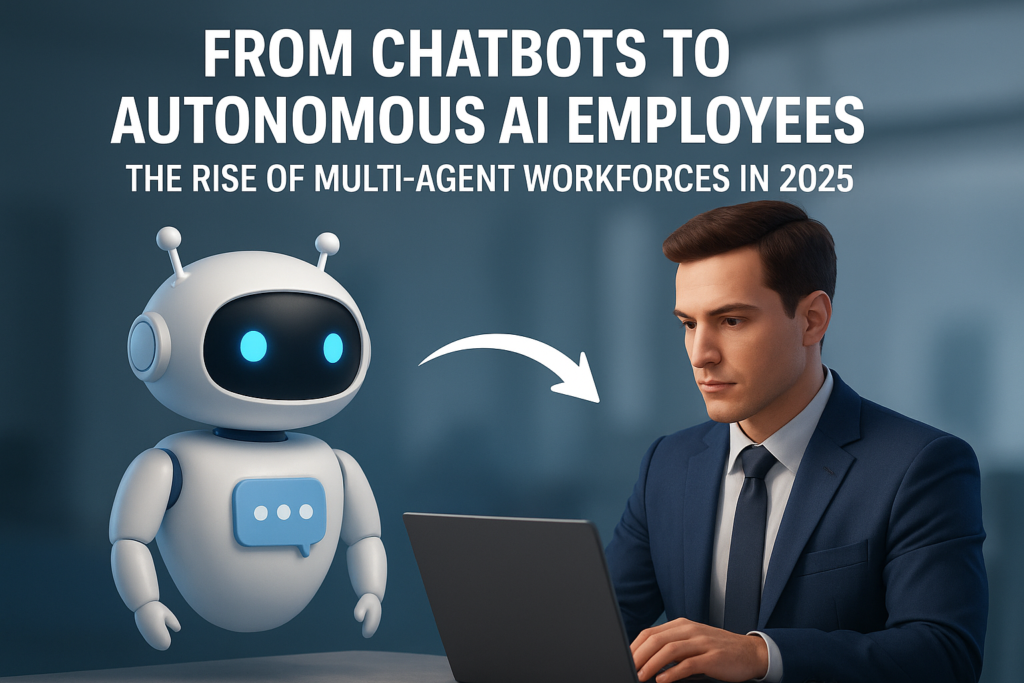
Artificial Intelligence has grown faster than anyone expected. What started as simple chatbots answering FAQs has now transformed into autonomous AI employees—smart, self-directed digital workers capable of completing tasks, making decisions, and collaborating just like human teams. And in 2025, the biggest shift is the rise of multi-agent workforces.
Let’s break down how this transformation happened, why it’s exploding in the USA, and what the future holds. 🚀
1. The Evolution: From Chatbots to Autonomous AI Agents
A few years ago, “AI” mostly meant chatbots. They could answer questions, follow scripts, and perform basic actions. But they had big limitations.
They couldn’t think, plan, or adapt.
2025 changed everything.
Today’s AI agents can:
- Understand goals
- Break tasks into steps
- Use tools and apps
- Learn from results
- Work without constant human supervision
This evolution happened because of three breakthroughs:
✔ Goal-driven intelligence
Agents no longer wait for commands—they act based on outcomes.
✔ Tool usage
They can search the web, analyze data, manage CRMs, write emails, create designs, and even run workflows.
✔ Autonomy
They don’t just respond. They execute.
This shift took AI from being an assistant to becoming a digital employee.
2. Multi-Agent Architecture: When Multiple AI Agents Work Together
A single AI agent is powerful—but a team of agents working together is a revolution.
Multi-agent ecosystems allow multiple agents to divide work like human teams. For example:
📌 Example: Marketing Team of AI Agents
- Research Agent: finds trends, studies competitors
- Writer Agent: creates content
- Designer Agent: generates visuals
- Analytics Agent: measures performance
- Project Manager Agent: coordinates all agents
They collaborate, communicate, assign tasks, and deliver results automatically.
Benefits of Multi-Agent Systems
- ⚡ Faster output
- 💰 Lower operational cost
- 🎯 More accurate decision-making
- 🔄 24/7 workflow execution
- 📈 Ability to handle complex projects end-to-end
This architecture is why companies in 2025 are replacing dozens of tools with one AI agent ecosystem.
3. Adoption in the USA: How SMBs & Big Enterprises Are Using AI Agents
AI agents are no longer just a “big tech” thing.
In 2025, every type of business in the USA—from small shops to multi-billion-dollar enterprises—is adopting them.
🟦 Small Businesses (SMBs)
SMBs use AI agents for:
- Customer support
- Sales outreach
- Social media posting
- Bookkeeping
- Lead generation
- Website management
Example: A small bakery can run marketing, inventory tracking, and customer messages using just AI agents—no full-time team needed.
🟩 Mid-Sized Companies
They adopt multi-agent workflows for:
- HR automation
- Recruiting
- Workflow management
- Financial reporting
- Internal communication
Many US companies replaced 3–5 employee roles with autonomous agents.
🟧 Enterprises & Corporations
Big companies now have:
- Agent-controlled data systems
- AI-driven operations centers
- Autonomous digital employees handling end-to-end processes
Industries adopting fastest:
- Finance
- Healthcare
- Real estate
- Logistics
- SaaS
- Ecommerce
Enterprises report:
- 45–70% operational speed increase
- 30–50% cost reduction
- Fewer human errors
USA is the global leader in deploying AI agents at scale in 2025.
4. Ethical & Security Challenges
With great power comes serious responsibility.
1️⃣ Data Privacy
AI agents handle sensitive customer and business data.
Poor security → big risks.
2️⃣ Decision-Making Transparency
If an AI denies a loan, fires an employee, or flags fraud…
Who is responsible?
Companies need strong audit trails.
3️⃣ Workforce Impact
AI agents replace repetitive jobs.
But they also create new jobs:
- AI supervisors
- Agent architects
- AI ethicists
- Prompt engineers
- Workflow designers
4️⃣ Bias & Fairness
Agents trained on biased data can make unfair decisions.
5️⃣ Autonomous Errors
If agents act independently, they can:
- Execute wrong tasks
- Send incorrect emails
- Misinterpret instructions
Strong monitoring + guardrails are essential.
2025 is the year companies are learning how to keep AI agents safe, fair, and accountable.
5. Future Outlook: Industries That Will Be Transformed Next
The next wave of AI agent transformation will hit these industries the most:
🏥 Healthcare
- AI doctor-assistants
- Patient monitoring agents
- Automated medical scheduling
- Insurance claim agents
🏦 Banking & Finance
- Fraud detection agents
- Risk analysis agents
- Automated investment agents
- Loan processing agents
🚚 Logistics & Supply Chain
- Route-planning agents
- Inventory agents
- Procurement agents
- Delivery coordination agents
📚 Education
- Personalized learning agents
- Automated grading
- Student progress trackers
📺 Media & Content Creation
- Multi-agent content studios
- Automated editing
- Social media orchestration
- Trend-prediction agents
⚙️ Manufacturing
- Quality control agents
- Maintenance monitoring
- Production planning agents
Conclusion
The world is shifting from simple chatbots to a new era of autonomous AI employees—and even more powerful, multi-agent workforces.
This transformation is reshaping American businesses, boosting efficiency, lowering costs, and opening the door to innovation we’ve never seen before.
2025 isn’t just another tech year.
It’s the year digital employees officially join the American workforce. 🇺🇸🤖